










Finding the right way to finance a home renovation can feel overwhelming, especially for homeowners in Moncton who want to improve comfort, boost property value, or increase energy efficiency. This challenge matters because major upgrades often require significant upfront costs and careful planning. By understanding renovation financing options designed for New Brunswick residents, you can discover smart strategies that help manage expenses, support sustainability goals, and provide peace of mind during your next renovation project.
Table of Contents
- What Is Renovation Financing And Why It Matters
- Popular Renovation Financing Types And Programs
- How The Application And Approval Process Works
- Key Requirements And Eligibility For Homeowners
- Costs, Risks, And Common Pitfalls To Avoid
- Smart Strategies And Financing Alternatives In 2026
Key Takeaways
| Point | Details |
|---|---|
| Renovation Financing Offers Flexibility | Homeowners can access specialized lending options to fund significant renovations without depleting savings. |
| Explore Diverse Financing Types | Various options, such as home equity loans and government grants, cater to different renovation needs. |
| Understand Application Requirements | Preparing necessary documentation and understanding credit assessments is crucial for securing favorable financing. |
| Be Aware of Potential Risks | Homeowners should anticipate cost overruns and regulatory changes, and create contingency budgets to mitigate financial pitfalls. |
What Is Renovation Financing and Why It Matters
Renovation financing represents a strategic financial approach that enables homeowners to fund home improvement projects through specialized lending options. By accessing targeted financial resources, property owners can transform their living spaces while managing the substantial upfront costs associated with significant renovations.
At its core, renovation financing provides structured monetary support designed specifically for home upgrade projects. These financial solutions help address critical challenges, including:
- Covering substantial renovation expenses
- Managing cash flow during construction
- Accessing funds without depleting personal savings
- Enabling energy efficiency upgrades
- Increasing property market value
The importance of renovation financing becomes particularly evident when considering the broader economic and environmental impact. Decarbonizing building sectors represents a critical global objective, with home renovations playing a significant role in reducing energy consumption and greenhouse gas emissions.
Homeowners in Moncton, New Brunswick, can leverage these financing options to enhance their properties strategically. Whether upgrading insulation, replacing windows, or conducting major structural improvements, renovation financing provides the financial flexibility needed to transform residential spaces effectively.
Pro tip: Research multiple financing options and compare interest rates, terms, and potential tax incentives before committing to a renovation loan.
Popular Renovation Financing Types and Programs
Homeowners exploring renovation financing have multiple strategic options to fund their home improvement projects. Understanding the diverse landscape of financing typologies for building renovation can help property owners make informed financial decisions tailored to their specific renovation needs.
The most prevalent renovation financing types include:
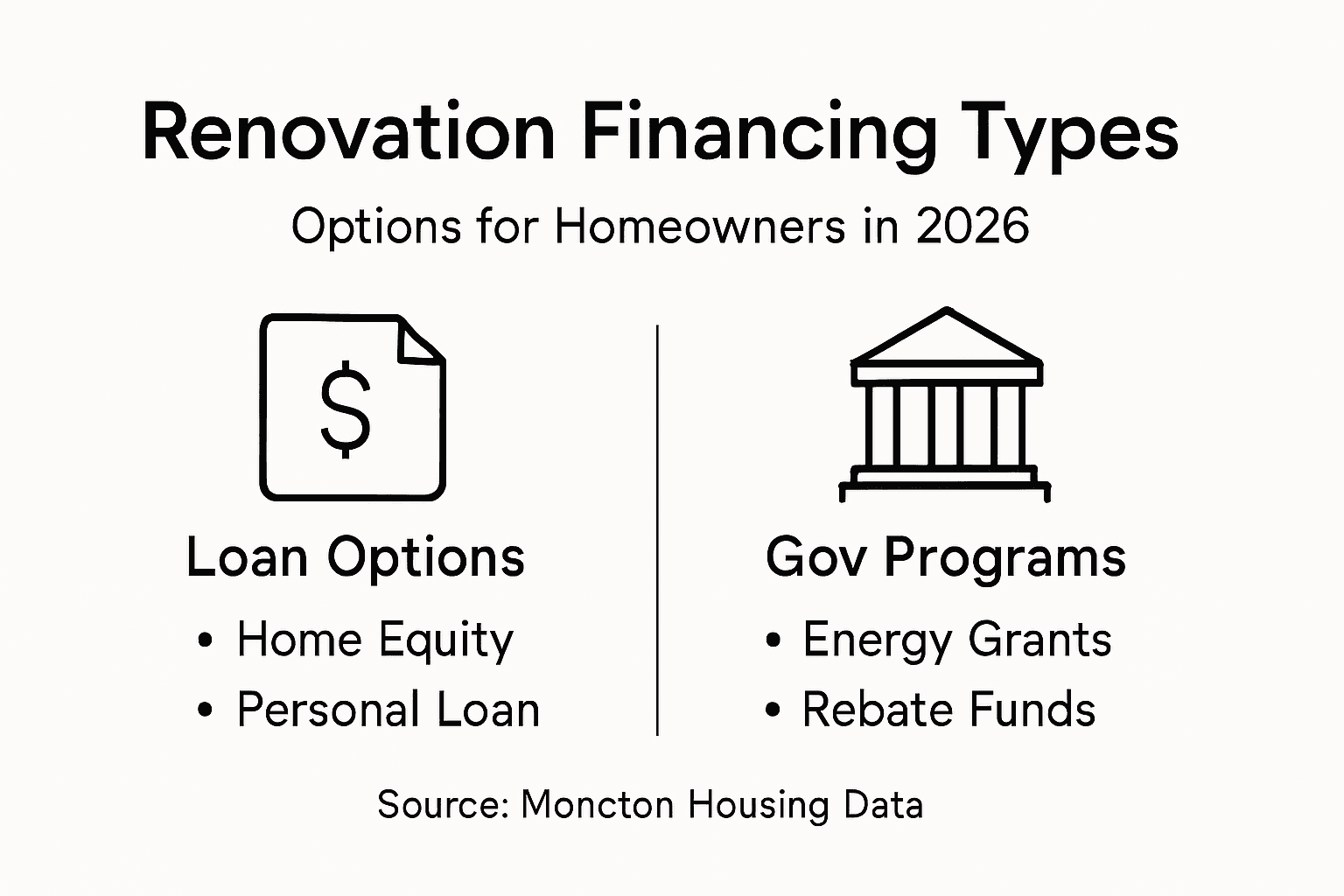
- Home Equity Loans: Leverage existing home equity for renovation funding
- Personal Renovation Loans: Unsecured financing with fixed interest rates
- Government Grants: Financial assistance for energy-efficient upgrades
- Home Improvement Lines of Credit: Flexible borrowing options
- Energy Efficiency Mortgages: Special loans designed for sustainable home improvements
Each financing method comes with unique advantages and considerations. Home equity loans typically offer lower interest rates since they’re secured by your property, while personal renovation loans provide faster access to funds without using home equity as collateral.

Government programs play a crucial role in supporting home renovations, particularly for energy efficiency projects. These initiatives often provide tax credits, subsidies, and low-interest loan options to encourage sustainable home improvements. Homeowners in Moncton can explore local and provincial programs that might offer financial incentives for specific renovation types.
Here’s a concise comparison of popular renovation financing types:
| Financing Type | Typical Interest Rate | Repayment Flexibility | Best For |
|---|---|---|---|
| Home Equity Loan | Lower, fixed rates | Fixed monthly payments | Large, planned renovations |
| Personal Renovation Loan | Higher, fixed rates | Shorter loan terms | Small to medium projects |
| Government Grant | No repayment, strict use | Non-repayable | Energy efficiency improvements |
| Home Improvement Line of Credit | Variable, moderate rates | Draw-as-needed, flexible | Ongoing or phased renovations |
| Energy Efficiency Mortgage | Competitive for upgrades | Bundled with mortgage | Major energy-saving retrofits |
Pro tip: Calculate your total renovation budget and compare multiple financing options, considering interest rates, loan terms, and potential tax benefits before making a final decision.
How the Application and Approval Process Works
Navigating the renovation financing application process requires careful preparation and understanding of application and approval requirements. Homeowners must systematically approach the process to increase their chances of securing favorable financing for their renovation projects.
Typical steps in the application and approval process include:
- Document Preparation: Gather financial statements, renovation plans, and proof of income
- Credit Assessment: Lenders evaluate creditworthiness and financial stability
- Project Evaluation: Review proposed renovation plans and potential value increase
- Eligibility Verification: Confirm compliance with lender and program-specific requirements
- Collateral Assessment: Determine property value and potential loan-to-value ratio
Most financial institutions require a comprehensive application package that demonstrates both the homeowner’s financial capability and the renovation project’s potential value. This typically involves submitting detailed renovation plans, contractor estimates, and a comprehensive financial profile that showcases your ability to repay the loan.
Specific requirements can vary between different financing options. Government-backed programs often have additional criteria focused on energy efficiency and sustainable improvements, while private lenders may place more emphasis on credit scores and existing home equity. Homeowners in Moncton should be prepared to provide extensive documentation and potentially undergo a property inspection as part of the approval process.
Pro tip: Consult with multiple lenders and gather all financial documents in advance to streamline the application process and improve your chances of approval.
Key Requirements and Eligibility for Homeowners
Understanding the comprehensive renovation financing eligibility criteria is crucial for homeowners seeking financial support for their renovation projects. These requirements ensure that funding is allocated effectively and supports meaningful home improvements.
Key eligibility requirements typically include:
- Property Ownership: Documented proof of property ownership
- Credit Score: Minimum credit rating threshold
- Income Verification: Stable income demonstrating loan repayment capacity
- Renovation Scope: Project alignment with program-specific improvement standards
- Property Condition: Home must meet basic structural integrity requirements
- Energy Efficiency Potential: Demonstrable improvements in home performance
Most renovation financing programs in Moncton and New Brunswick have specific criteria tailored to local housing markets and energy efficiency goals. Homeowners must typically provide comprehensive documentation including detailed renovation plans, contractor estimates, current property assessments, and proof of financial stability.
Different financing options may have unique eligibility requirements. Government-backed programs often prioritize energy-efficient upgrades and may offer more flexible terms for homeowners implementing sustainable improvements. Private lenders, conversely, tend to focus more stringently on credit scores, existing home equity, and overall financial health.
Pro tip: Conduct a preliminary financial review and gather all necessary documentation before applying to streamline your renovation financing application process.
Costs, Risks, and Common Pitfalls to Avoid
Home renovation financing involves complex financial considerations that homeowners must carefully navigate. Unlocking private financing for deep energy renovation requires a comprehensive understanding of potential risks and financial challenges.
Common risks and potential pitfalls include:
- Cost Overruns: Unexpected expenses exceeding initial project budgets
- Interest Rate Fluctuations: Variable rates increasing total financing costs
- Project Scope Creep: Expanding renovation plans beyond initial estimates
- Technical Complexity: Underestimating required technical expertise
- Regulatory Compliance: Potential changes in building codes or financing regulations
- Energy Savings Miscalculation: Lower-than-anticipated efficiency improvements
Moncton homeowners should be particularly cautious about financial commitments that could strain their long-term economic stability. Comprehensive planning involves not just understanding the immediate renovation costs, but also considering potential hidden expenses, maintenance requirements, and the overall return on investment.
Financing risks can be mitigated through thorough research, obtaining multiple contractor estimates, creating contingency budgets, and working with reputable financial institutions that specialize in renovation lending. Homeowners should carefully review all contract terms, understand the full scope of repayment obligations, and maintain flexibility in their financial planning.
To help homeowners prepare, here is a summary of common renovation financing risks and ways to reduce them:
| Risk Factor | Potential Impact | Mitigation Strategy |
|---|---|---|
| Cost Overruns | Higher total project cost | Set a 15-20% contingency budget |
| Rate Fluctuations | Increased repayment amounts | Choose fixed-rate loans where possible |
| Regulatory Changes | Project delays or new expenses | Stay updated on local codes |
| Underestimated Scope | Incomplete or delayed renovations | Get multiple contractor estimates |
Pro tip: Create a detailed contingency fund of 15-20% above your estimated renovation budget to protect against unexpected expenses and potential financial surprises.
Smart Strategies and Financing Alternatives in 2026
The renovation financing landscape is rapidly evolving, with innovative approaches transforming how homeowners fund home improvements. Emerging financial technology solutions are democratizing access to capital and creating more flexible funding options for residential renovations.
Cutting-edge financing strategies in 2026 include:
- Blockchain Smart Contracts: Transparent, secure financing agreements
- Crowdfunding Platforms: Community-based renovation investment
- Energy Performance Contracting: Risk-transfer financing models
- Tokenized Investment Vehicles: Fractional property improvement funding
- Hybrid Financing Models: Combining multiple funding sources
- Digital Lending Platforms: Streamlined online application processes
Moncton homeowners can leverage these innovative approaches to overcome traditional financing barriers. Digital platforms and alternative funding mechanisms are making renovation financing more accessible, transparent, and tailored to individual project needs. The key is understanding how these emerging strategies can be strategically combined to maximize financial flexibility and minimize risk.
Technological advancements are particularly transformative in renovation financing. By integrating circular economy principles and leveraging data-driven assessment tools, homeowners can now access more personalized and efficient financing solutions that align with both financial constraints and sustainability goals.
Pro tip: Research and compare multiple digital financing platforms, focusing on those offering transparent terms, low transaction costs, and flexible repayment options.
Take Control of Your Home Renovation Financing Today
Navigating renovation financing options in 2026 can feel overwhelming with all the technical terms and potential financial risks involved. If you are planning upgrades in Moncton and want to avoid surprises like cost overruns or complicated approval processes you need a trusted partner who understands both smart financing choices and quality craftsmanship. From energy efficiency improvements to major structural renovations aligning with your budget and goals is easier when you team up with experienced professionals.
Explore the wide range of services we offer in the Home Renovation Archives – J. A. Kelly Contracting Services to find reliable craftsmanship that complements your financing plans. Ready to start your project with confidence backed by expert guidance and local knowledge Visit J. A. Kelly Contracting Services now to request a free estimate and book your consultation. Don’t wait — secure your home’s value and comfort by making smart renovation financing work for you today!
Frequently Asked Questions
What is renovation financing?
Renovation financing refers to specialized financial options that help homeowners fund home improvement projects without the need for substantial upfront costs. It includes various lending solutions tailored for renovations.
What are the common types of renovation financing available?
Common types of renovation financing include home equity loans, personal renovation loans, government grants for energy-efficient upgrades, home improvement lines of credit, and energy efficiency mortgages.
How does the application process for renovation financing typically work?
The application process usually involves preparing financial documents, undergoing a credit assessment, having the proposed renovation evaluated, verifying eligibility, and assessing collateral. Homeowners should be prepared to provide detailed project plans and financial profiles.
What should I consider to avoid common pitfalls in renovation financing?
To avoid pitfalls, be mindful of cost overruns, interest rate fluctuations, project scope creep, and regulatory compliance. Developing a contingency budget and obtaining multiple contractor estimates can help mitigate financial risks.
Recommended
- Roofing Financing Options Explained: Complete Guide – J. A. Kelly Contracting Services
- 7 Key Advantages of Home Renovation for Homeowners – J. A. Kelly Contracting Services
- What Is a Renovation Contract? Complete Overview – J. A. Kelly Contracting Services
- How to Budget Renovations for Maximum Value at Home – J. A. Kelly Contracting Services
- Gutter Cleaning Trends 2026: Efficiency and Sustainability Impact