









“A single miscalculation in a renovation estimate can cost homeowners in Moncton thousands more than planned, a fact that every American contractor understands well. Planning a remodel without a clear financial forecast can leave budgets stretched and stress levels high. This guide helps Moncton homeowners uncover what really goes into a reliable renovation estimate so you can approach your next project with clarity and confidence.”
Table of Contents
- What Is A Renovation Estimate? Core Concepts
- Types Of Renovation Estimates And Approaches
- Key Elements Of A Home Renovation Estimate
- Legal Factors And Insurance Considerations
- Common Risks And Cost Overruns To Avoid
Key Takeaways
| Point | Details |
|---|---|
| Understanding Renovation Estimates | A renovation estimate provides a detailed financial projection of project expenses, essential for budgeting. It includes direct and indirect cost components, allowing homeowners to manage their budget effectively. |
| Estimation Methods | Different estimation methods (Analogy, Parametric, Engineering, Actual Cost Tracking) vary in accuracy and are suitable for different project stages, helping homeowners align financial expectations. |
| Legal and Insurance Considerations | Clear legal documentation and insurance protections are vital to ensuring safe and secure renovation processes, safeguarding both contractors and homeowners. |
| Managing Risks and Cost Overruns | Establishing contingency funds and maintaining detailed project change logs can mitigate risks, keeping renovation budgets on track despite unforeseen challenges. |
What Is a Renovation Estimate? Core Concepts
A renovation estimate is a comprehensive financial projection that provides homeowners a detailed breakdown of anticipated project expenses. When planning home improvements in Moncton, understanding construction cost components becomes essential for budgeting and financial planning.
Typically, a renovation estimate includes multiple critical elements that help predict total project costs. These components encompass materials, labor, equipment rentals, permit fees, and potential contingency expenses. The accuracy of an estimate improves as project details become more refined, transitioning from broad initial projections to increasingly precise calculations. Early estimates might have wider cost ranges, while later iterations can pinpoint expenses with greater precision.
Professional contractors develop renovation estimates by carefully analyzing project specifications, measuring required materials, calculating labor hours, and incorporating regional pricing factors specific to New Brunswick. This meticulous process ensures homeowners receive a transparent financial roadmap that minimizes unexpected expenses and helps manage budget expectations. Early cost projections play a crucial role in determining project feasibility and aligning design goals with available financial resources.
Pro tip: Request detailed written estimates from multiple contractors and compare them line by line to understand exactly what is included in each proposal.
Types of Renovation Estimates and Approaches
Homeowners in Moncton planning renovations should understand the various estimation methods used by contractors to predict project costs. Cost estimation approaches range from broad initial projections to increasingly precise calculations that help manage financial expectations.
Four primary estimation methods dominate residential renovation planning:
- Analogy Estimates: Compare costs with similar previous projects, providing rough initial projections
- Parametric Estimates: Use statistical models and historical data to generate more refined cost predictions
- Engineering (Bottom-Up) Estimates: Develop detailed calculations by breaking down each project component
- Actual Cost Tracking: Monitor real-time expenses during the renovation process
Early stage renovation planning often relies on Rough Order of Magnitude (ROM) estimates, which provide broad cost ranges typically within 20% accuracy. These initial projections help homeowners assess project feasibility before investing significant time and resources into detailed design work. As the renovation concept becomes more defined, contractors transition to more precise estimation techniques that incorporate specific material costs, labor requirements, and regional pricing factors.
Pro tip: Request estimates using multiple calculation methods to gain a comprehensive understanding of potential project expenses.
The table below summarizes and compares the main renovation estimate methods and when they are most useful:
| Method | Accuracy Level | Best Use Case | Example Scenario |
|---|---|---|---|
| Analogy Estimates | Low to Moderate | Early-stage budgeting | Similar kitchen remodel |
| Parametric Estimates | Moderate | Mid-stage planning, repeat projects | Apartment unit upgrades |
| Engineering (Bottom-Up) | High | Detailed design and final pricing | Full home restructuring |
| Actual Cost Tracking | Ongoing | Cost control during construction | Monitoring live expenses |
Key Elements of a Home Renovation Estimate
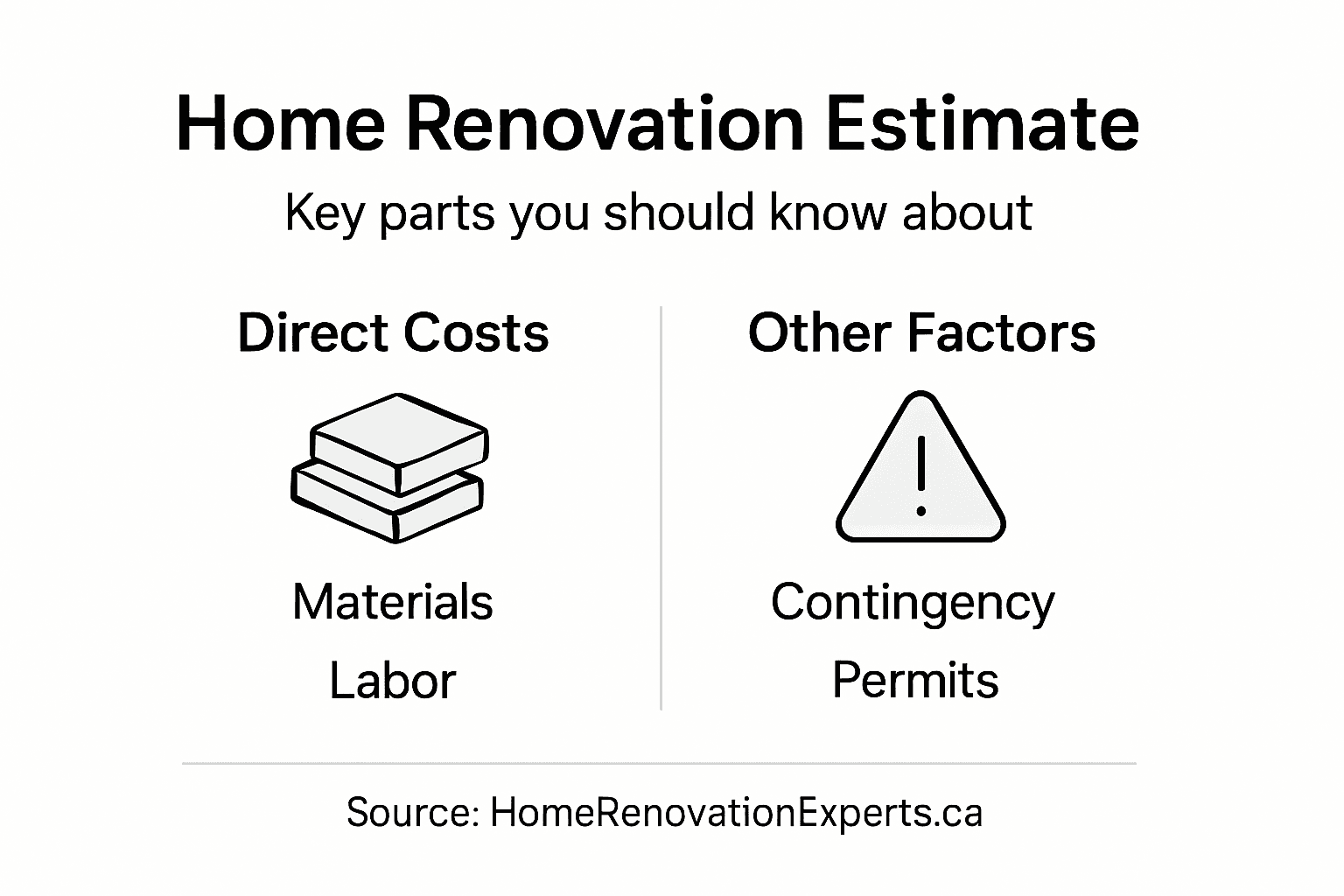
A comprehensive home renovation estimate encompasses multiple critical financial components that help Moncton homeowners understand their potential investment. Detailed cost breakdowns reveal the intricate financial landscape of home improvement projects, providing transparency and predictability.

The estimate typically includes two primary cost categories:
Direct Costs:
- Materials and supplies
- Labor expenses
- Equipment rentals
- Specialized tools
- Specific project components
Indirect Costs:
- Overhead expenses
- Contractor profit margins
- Permit and inspection fees
- Insurance and liability coverage
- Project management expenses
Beyond basic expenses, comprehensive renovation estimates consider long-term financial implications. This includes potential operational costs like future maintenance, utility adjustments, and potential property value improvements. Professional contractors in Moncton understand that a true estimate goes beyond immediate expenses, providing homeowners a holistic financial projection that accounts for both short-term investments and potential long-term benefits.
Pro tip: Request a line-by-line breakdown of your estimate to understand exactly where each dollar of your renovation budget will be allocated.
Here is a quick reference guide to the typical cost components in a home renovation estimate:
| Cost Component | Description | Example Cost Element |
|---|---|---|
| Direct Costs | Expenses strictly for physical work | Flooring, labor hours |
| Indirect Costs | Overhead and administrative expenses | Insurance, permits, profits |
| Future Expenses | Ongoing or added long-term costs | Maintenance, utility upgrades |
| Value Additions | Financial benefits after renovation | Increased property value |
Legal Factors and Insurance Considerations
Home renovation projects in Moncton require careful navigation of legal and insurance requirements that protect both homeowners and contractors. Comprehensive legal documentation forms the foundation of a transparent and secure renovation process, establishing clear expectations and boundaries for all parties involved.
Key Legal Documentation Requirements:
- Basis of Estimate (BOE): Detailed document outlining project
- Specific assumptions
- Clear inclusions and exclusions
- Precise project scope
- Contractual Agreements: Legally binding documents specifying
- Project timelines
- Payment schedules
- Performance expectations
- Insurance Protections: Critical safeguards including
- Performance bonds
- Liability coverage
- Workmanship guarantees
Professional standards for cost estimation mandate comprehensive risk management strategies. These legal frameworks protect homeowners from potential financial risks, ensuring that renovation projects are completed according to agreed specifications and quality standards. Contractors must provide clear documentation that outlines potential contingencies, insurance coverages, and mechanisms for addressing unexpected challenges during the renovation process.
Pro tip: Always request and thoroughly review a contractor’s detailed legal documentation and insurance certificates before signing any renovation agreement.
Common Risks and Cost Overruns to Avoid
Home renovation projects in Moncton frequently encounter financial challenges that can derail budgets and expectations. Common project risks include unpredictable variables that can significantly impact overall project costs and timelines.
Primary Risk Categories:
- Scope Changes
- Unexpected design modifications
- Additional feature requests
- Midproject design alterations
- Material Price Fluctuations
- Sudden market price shifts
- Supply chain disruptions
- Regional inventory constraints
- Unforeseen Site Conditions
- Hidden structural issues
- Unexpected infrastructure challenges
- Compliance requirement discoveries
Economic factors affecting remodeling costs demonstrate that successful renovation management requires proactive planning and flexible budgeting strategies. Contractors and homeowners must collaborate to establish realistic contingency funds, typically ranging from 10-20% of the total project budget. This financial buffer helps mitigate risks associated with unexpected expenses, material price changes, and potential labor market fluctuations specific to the Moncton region.
Pro tip: Create a detailed project change log and require written approval for any modifications to prevent uncontrolled budget expansion.
Take Control of Your Home Renovation Budget with Expert Estimates
Understanding the complexities of renovation estimates can be overwhelming. This article highlights key pain points such as unpredictable costs, scope changes, and the importance of detailed budgeting. If you want to avoid unexpected expenses and gain clear insights into your project’s financials, partnering with a trusted local contractor is essential. At J. A. Kelly Contracting Services, we specialize in providing detailed, transparent renovation estimates that align with your goals and keep your project on track.
Ready to make your dream renovation a reality without financial surprises? Explore our Home Renovation Archives – J. A. Kelly Contracting Services for inspiration, and trust our experienced team to deliver quality craftsmanship. Visit our main site at https://jakellycontractingservices.ca to request your free, detailed estimate today and start your project with confidence.
Frequently Asked Questions
What is included in a renovation estimate?
A renovation estimate typically includes direct costs such as materials, labor, equipment rentals, and specialized tools, as well as indirect costs like overhead, permit fees, and contractor profit margins.
How can I improve the accuracy of my renovation estimate?
Improving the accuracy of a renovation estimate can be achieved by providing detailed project specifications and measurements, as well as requesting estimates from multiple contractors to compare costs.
What are the different methods for estimating renovation costs?
Common methods for estimating renovation costs include analogy estimates, parametric estimates, engineering (bottom-up) estimates, and actual cost tracking, each with varying levels of accuracy and application during the renovation planning process.
How should I handle unexpected costs during a renovation?
To handle unexpected costs, it is advisable to establish a contingency fund of 10-20% of the total project budget and maintain open communication with your contractor to address any changes or unforeseen circumstances promptly.
Recommended
- How to Plan Home Renovation: Step-by-Step Guide for Homeowners – J. A. Kelly Contracting Services
- Why Get a Free Estimate: Avoiding Surprises in Renovations – J. A. Kelly Contracting Services
- Renovation Planning: Avoiding Costly Home Mistakes – J. A. Kelly Contracting Services
- What Is Bathroom Renovation? Complete Overview – J. A. Kelly Contracting Services